 |
| A recent photo of Fr. Lai Fook http://www.catholictt.org/
LAI FOOK, Fr. Arthur C.S.Sp. died on 19th April at Lourdes House, Arouca at the age of 93. Priest of over 65 years, he was ordained on 20th July, 1947.
Uncle, great uncle and great-great uncle of the Lai Fook, Jay Williams and Huggins-Chan families. An Evening Prayer vigil will take place at 6:00 p.m. on Wednesday 24th April 2013 at St. Mary’s College Chapel. His funeral liturgy will be celebrated on Thursday 25thApril, 2013 at 9:30 a.m. at St. Theresa’s Church, Woodbrook, followed by interment at Lapeyrouse Cemetery.

I knew Fr. Lai Fook from attending morning Mass during the week at the St Mary's Chapel (College of the Imaculate Conception) which is located on Frederick St, Port of Spain. To be honest I cannot recall him saying Mass while I was at school, however it was after leaving school, that I observed him saying Mass there. Funny how I can remember that now, as at that time I did not know his name, he was just a priest saying Mass that day.
Now I would say that he reminded me of Yoda from Star Wars, perhaps it was the combination of priestly robes, the shape of the head, the hair or lack thereof. At that time, I think that I was too dumbstruck on seeing him, to do more than smile and leave the Chapel, slowly.
On seeing the younger picture of him , which was posted with an article on the celebration on Friday, July 20, 2007 of the 60th anniversary of priestly ordination of Fr Arthur Lai Fook CSSp (diamond jubilee), I am noticing what we call "Bat ears" so maybe we are related as that size and shape of ears run in my family also, as well as the tendency for our hair to spike when it is cut short.
|
Saturday, 27 April 2013
Remembering Fr. Arthur Lai Fook C.S.Sp. 1919-2013

Wednesday, 17 April 2013
Another University's approach to sharing: A link to "access to scholarships for persons 13+"

http://www.udayton.edu/flyersfirst/financialaid/resources/index.php
In comparing the styles of sharing /giving by Duquense University and Unviersity of Dayton, I had to pause, save the draft and revisit what I was seeing, as at a glance access to aid/scholarships was not apparent. Then I started viewing the links such as:
Special Programs»http://www.udayton.edu/flyersfirst/financialaid/resources/special_programs.php- Tax Benefits» http://www.udayton.edu/flyersfirst/financialaid/resources/tax_benefits.php
- External Scholarships» http://www.udayton.edu/flyersfirst/financialaid/resources/external_scholarships.php.
I was especially intrigued by Scholarship Experts which is accessed on External Scholarships, whereby you can access a scholarship for $3000. This applies to those who are thirteen years (13) and older. Imagine how this can help students!
In short, I think that there are many different ways to give anything, sometimes the method and means of giving may be apparent and sometimes either may not be.
THE FASTEST WAY TOFREE COLLEGE MONEY
ScholarshipExperts.com has been helping parents and students find scholarships and free college money since 2001.Save time and search for scholarships now
I've been Reading: Rangers Series by John Flanagan

 Currently I've been reading the Rangers series by John Flanagan. The source of the books is one of my nephews and its selection has been due to it being available and being intrigued by the book, to continue reading it, after picking it up and starting in the centre of it. The series is on the adventures of a boy who is into adolescence who did not know his parentage at a time when your parentage determined your outlook and to some extent your outcome in life. As an adult I have been reading books written for children which can stimulate their thinking on life's issues and to some extent those types of books have been what shaped my thinking to sone extent, so that
reading Mr. Pink Whistle by Enid Blyton led to an appreciation of Harry Potter as an adult. The appreciation was not for the spells and all of the purported things to be aware of as a good Christian, nor for the power on the subconscious, but for the use of the imagination. There was also appreciation for the changes in the characters over the series of the books, their constancy as well as their evolution, the role of other characters who were seemingly unimportant to the main theme, but who had a role to play. Call me naive and simplistic, but sometimes the qualities which the characters display, add more to the stimulation of the brain than all of the spells and charms. Comparing the books to the movies, I realised that some of the qualities which enthrall me in the books are not what are highlighted in the movies as the movies are geared towards an audience and an age group. Also while you can read a book many times and see a different perspective with each reading, with a movie that may be difficult to achieve. Maybe I lack visual stimulation.
Saturday, 13 April 2013
Mark the Evangelist
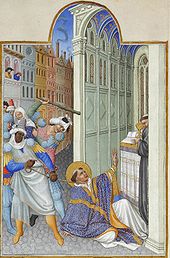 |
| The martyrdom of Saint Mark.Très Riches Heures du duc de Berry (Musée Condé, Chantilly). |

Illumination of St. Mark in the 11th century Trebizond Gospel
Mark the Evangelist (Latin: Mārcus; Greek: Μᾶρκος; Coptic: Μαρκοϲ; Hebrew: מרקוס) is the traditional author of the Gospel of Mark. He is one of the Seventy Disciples, and the founder of the Church of Alexandria, one of the original four main episcopal sees ofChristianity.
According to William Lane (1974), an "unbroken tradition" identifies Mark the Evangelist with John Mark,[3] and John Mark as the cousin of Barnabas.[4] An exception is found in Hippolytus of Rome, who in his work On the Seventy Apostles, distinguishes Mark the Evangelist (2 Tim 4:11), John Mark (Acts 12:12, 25; 13:5, 13; 15:37), and Mark the cousin of Barnabas (Col 4:10; Phlm 24).[5]According to Hippolytus, they all belonged to the "Seventy Disciples" who were sent out by Jesus to saturate Judea with the gospel(Luke 10:1ff.). However, when Jesus explained that his flesh was "real food" and his blood was "real drink", many disciples left him (John 6:44-6:66), presumably including Mark. He was later restored to faith by the apostle Peter; he then became Peter’s interpreter, wrote the Gospel of Mark, founded the church of Africa, and became the bishop of Alexandria.
 |
| St. Mark by Donatello (Orsanmichele, Florence). |
In 1063, during the construction of a new basilica in Venice, St. Mark's relics could not be found. However, according to tradition, in 1094 the saint himself revealed the location of his remains by extending an arm from a pillar.[26] The newfound remains were placed in a sarcophagus in the basilica.[23]
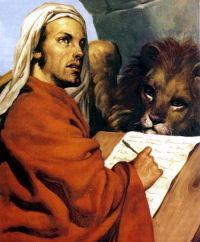  |
| The interior of Saint Mark's Nave today |
The second Gospel was written by St. Mark, who, in the New Testament, is sometimes called John Mark. Both he and his mother, Mary, were highly esteemed in the early Church, and his mother's house in Jerusalem served as a meeting place for Christians there.
In searching for information on St. Mark, I came across information on the "Saint Mark’s Cathedral"
Note: The Episcopal Church is part of the worldwide Anglican Communion of Churches, tied by faith and practice to the Church of England (the Archbishop of Canterbury being the spiritual leader).
The Anglican Church came to this continent with the English colonists of the 17th and 18th centuries. After the Revolutionary War, allegiance to the British Crown was impossible, and in 1785 the first General Convention established the Episcopal Church in the United States. Samuel Seabury was elected the first Bishop, thereby replacing the oversight of the Bishop of London. The General Convention approved the first American “Book of Common Prayer” in 1789. (The General Convention is the governing body of the Episcopal Church, consisting of the House of Bishops and the elected House of Deputies. Both houses must agree on legislation that comes before the convention for consideration.)

ORGAN PLUS CONCERT
Sunday, April 14th, 2013 at 2 PM
Norma Aamodt-Nelson and Kristin Olson will present a concert of music for organ and oboe including compositions by Walther, Bruhns, and David Dahl in Thomsen Chapel, St. Mark’s Cathedral (1245 10th Avenue E. (Capitol Hill) ~ Seattle).
Ms. Aamodt-Nelson is Organist/Music Director at Trinity Lutheran Church, Lynnwood, WA and Kristin Olson, a Julliard School of Music graduate, performs with Pacific Musicworks and other early music groups as baroque oboist. She will play both baroque and modern oboe in this concert.
Admission: $10 suggested donation at the door or advance passes available at the Cathedral Shop. http://www.shopatsaintmarks.org/
The Greater Litanies

Sunday, April 14th, 2013 at 2 PM
Norma Aamodt-Nelson and Kristin Olson will present a concert of music for organ and oboe including compositions by Walther, Bruhns, and David Dahl in Thomsen Chapel, St. Mark’s Cathedral (1245 10th Avenue E. (Capitol Hill) ~ Seattle).
Ms. Aamodt-Nelson is Organist/Music Director at Trinity Lutheran Church, Lynnwood, WA and Kristin Olson, a Julliard School of Music graduate, performs with Pacific Musicworks and other early music groups as baroque oboist. She will play both baroque and modern oboe in this concert.
Admission: $10 suggested donation at the door or advance passes available at the Cathedral Shop. http://www.shopatsaintmarks.org/
The Greater Litanies
This day is honored in the Liturgy by what is called Saint Mark’s Procession. The term, however, is not a correct one, inasmuch as a procession was a privilege peculiar to April 25 previously to the institution of our Evangelist’s feast, which even so late as the sixth century had no fixed day in the Roman Church. The real name of this procession is The Greater Litanies. The word Litany means Supplication, and is applied to the religious rite of singing certain chants whilst proceeding from place to place in order to propitiate heaven. The two Greek words Kyrie eleison (Lord, have mercy on us) were also called Litany, as likewise were the invocations which were afterwards added to that cry for mercy, and which now form a liturgical prayer used by the Church on certain solemn occasions.
The Greater Litanies (or processions) are so called to distinguish them from the Minor Litanies, that is, processions of less importance as far as the solemnity and concourse of the faithful were concerned. We gather from an expression of St. Gregory the Great that it was an ancient custom in the Roman Church to celebrate, once each year, a Greater Litany, at which all the clergy and people assisted. This holy Pontiff chose April 25 as the fixed day for this procession, and appointed the Basilica of St. Peter as the Station.
Several writers on the Liturgy have erroneously confounded this institution with the processions prescribed by St. Gregory for times of public calamity. It existed long before his time, and all that he did was to fix it on April 25. It is quite independent of the feast of St. Mark, which was instituted at a much later period. If April 25 occur during Easter week, the procession takes place on that day (unless it be Easter Sunday), but the feast of the Evangelist is not kept till after the octave.
The Greater Litanies (or processions) are so called to distinguish them from the Minor Litanies, that is, processions of less importance as far as the solemnity and concourse of the faithful were concerned. We gather from an expression of St. Gregory the Great that it was an ancient custom in the Roman Church to celebrate, once each year, a Greater Litany, at which all the clergy and people assisted. This holy Pontiff chose April 25 as the fixed day for this procession, and appointed the Basilica of St. Peter as the Station.
Several writers on the Liturgy have erroneously confounded this institution with the processions prescribed by St. Gregory for times of public calamity. It existed long before his time, and all that he did was to fix it on April 25. It is quite independent of the feast of St. Mark, which was instituted at a much later period. If April 25 occur during Easter week, the procession takes place on that day (unless it be Easter Sunday), but the feast of the Evangelist is not kept till after the octave.
Wednesday, 10 April 2013
My Father
 For every bit of knowledge that I have acquired on my father, based either on knowledge acquired in school, or what I was told or through interaction, I am sure that there are other bits, that I do not know. For example, for a good number of years, my father spent time at a location that seemed to have been derived from another era. There were the small stores with the cobbler and the tailor in one block, with another block containing a two story building which housed apartments or rooms which were available for rent either at a fairly cheap price or which was obtained through the provision of other services such as the vending of tickets at the only cinema in the area. Not to be prejudiced, but these places were built out of concrete blocks and seemed to be of a quality which was comparable to buildings in other "better off" areas, yet they were located in a part of town which would not have been called "well off". God alone knows what the earnings on these buildings were, whether they ever paid for themselves or whether the act of providing decent housing mattered more than cash flow or profit. Along with this desire to provide decent housing (which may not have related to my father), was respect for the elderly. This was seen in the visits to the "old couple" who retained a way of life that they seemed to have had for years. One of the habits was buying fish in the market every day which was to be cooked in olive oil and was to be eaten with ground provision. I am not sure if this eating of fish arose from a bet he had made with these persons or from a good Catholic background which was no longer admitted to.
Another bit of knowledge came in the various sources of knowledge which he possessed. For all of my learnings, I could not understand or determine the source of his information, as all of it just did not add up for me. Maybe I did not want to speculate at that time, as it would have seemed to be an invasion of his privacy.
Over the last few years, in the course of my travels to the various islands, when I see the similarity in the buildings, I cannot help but wonder, was my father here and at what point in time and what was the impact of this place on him.
Sunday, 7 April 2013
Caribbean History: Toussaint Loverture & MUPANAH
 |
| the statue of Louverture in Port-au-Prince (Photo: OPM Haiti) |
In 1983, the remains of Louverture were placed at the MUPANAH site. The Musée du Panthéon National Haïtien (MUPANAH) is a museum featuring the heroes of the independence of Haiti and the Haitian history and culture.
The museum traces Taínos, Spanish, and a section dedicated to the heroes of independence including silver gun with which Henri Christophe committed suicide and the bell used to announce the independence. It also contains chains of slavery, torture instruments, sculptures and temporary exhibitions of paintings. Another curiosity, the anchor of the Caravel of Christopher Columbus, the Santa María (ship) measuring 4 meters high.[2]
Divine Mercy
Today is Divine Mercy Sunday and this day is specially important as a message continuing from Easter. In practical terms, this is a modern day message following Easter. After all many not be able to relive the Easter Triduum every day, but they can live out "Divine Mercy" which is a gentler message of hope, forgiveness, charity and love. Here are excerpts from wikipedia on this aspect of our faith:
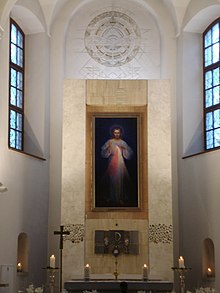 |
| The first Divine Mercy painting byKazimierowski (1934) |
Divine Mercy Sunday is a Roman Catholic solemnity celebrated on the Sunday after Easter, the Octave of Easter. It is originally based on the Catholic devotion to the Divine Mercy that Saint Faustina Kowalska reported as part of her encounter with Jesus, and is associated with special promises from Jesus and indulgences issued by the Church. http://en.wikipedia.org/wiki/Divine_Mercy_Sunday
"The Chaplet of the Divine Mercy is a Roman Catholic devotion based on the visions of Jesus reported by Saint Mary Faustina Kowalska (1905-1938), known as "the Apostle of Mercy."[1][2] She was a Polish sister of the Congregation of the Sisters of Our Lady of Mercy and canonized as a Catholic saint in 2000.[3]
Faustina stated that she received the prayer through visions and conversations with Jesus, who made specific promises regarding the recitation of the prayers.[1] Her Vatican biography quotes some of these conversations.[3]
The chaplet is often said as a rosary-based prayer with the same set of rosary beads used for reciting the Holy Rosary or the Chaplet of Holy Wounds. The chaplet may also be said without beads, usually by counting prayers on the fingertips,[1] and may be accompanied by the veneration of the Divine Mercy image.[4][5]
The English version of the Chaplet
The chaplet is often said as a rosary-based prayer with the same set of rosary beads used for reciting the Holy Rosary or the Chaplet of Holy Wounds. The chaplet may also be said without beads, usually by counting prayers on the fingertips,[1] and may be accompanied by the veneration of the Divine Mercy image.[4][5]
 |
| The chaplet is often recited on beads as a rosary-based prayer |
[9] was published in 1987. The chaplet contains the initial prayers as in a Rosary, then proceeds on the beads, adding specific offerings to the Father on the larger beads. On the smaller beads, it has specific other petitions for mercy. It then concludes by repeating a specific prayer for mercy.[9]
The Sign of the Cross on the Crucifix;
On large bead
Opening prayer: You expired, Jesus, but the source of life gushed forth for souls, and the ocean of mercy opened up for the whole world. O Fount of Life, unfathomable Divine Mercy, envelop the whole world and empty Yourself out upon us.[12]
Repeated three times: O Blood and Water, which gushed forth from the Heart of Jesus as a fountain of Mercy for us, I trust in You![12]
On three smaller beads, one Our Father, one Hail Mary, and The Apostles' Creed
For each of the five decades:
On large bead: Eternal Father, I offer you the Body and Blood, Soul and Divinity of Your Dearly Beloved Son, Our Lord, Jesus Christ, in atonement for our sins and those of the whole world.
Repeated on each of the ten small Beads: For the sake of His sorrowful Passion, have mercy on us and on the whole world.
Concluding prayers:
Doxology, repeated three times: Holy God, Holy Mighty One, Holy Immortal One, have mercy on us and on the whole world.
Closing Prayer: Eternal God, in whom mercy is endless and the treasury of compassion — inexhaustible, look kindly upon us and increase Your mercy in us, that in difficult moments we might not despair nor become despondent, but with great confidence submit ourselves to Your holy will, which is Love and Mercy itself.[13]
Conclude with the Sign of the Cross.
 John Paul II Institute of Divine Mercy
In 1996 Fr. Seraphim Michalenko, MIC, and Fr. George Kosicki, CSB formed the John Paul II Institute of Divine Mercy to provide instruction in Divine Mercy theology and spirituality to both parish leaders and clergy. At its inception, Pope John Paul II entrusted the Institute with the task of providing "formation and research in The Divine Mercy message". Their role in spreading the Divine Mercy message was acknowledged by Pope John Paul II in a special Papal Blessing in 2001, the 70th anniversary of the revelation of the Divine Mercy Message and Devotion.
John Paul II Institute of Divine Mercy
In 1996 Fr. Seraphim Michalenko, MIC, and Fr. George Kosicki, CSB formed the John Paul II Institute of Divine Mercy to provide instruction in Divine Mercy theology and spirituality to both parish leaders and clergy. At its inception, Pope John Paul II entrusted the Institute with the task of providing "formation and research in The Divine Mercy message". Their role in spreading the Divine Mercy message was acknowledged by Pope John Paul II in a special Papal Blessing in 2001, the 70th anniversary of the revelation of the Divine Mercy Message and Devotion.
The Sign of the Cross on the Crucifix;
On large bead
Opening prayer: You expired, Jesus, but the source of life gushed forth for souls, and the ocean of mercy opened up for the whole world. O Fount of Life, unfathomable Divine Mercy, envelop the whole world and empty Yourself out upon us.[12]
Repeated three times: O Blood and Water, which gushed forth from the Heart of Jesus as a fountain of Mercy for us, I trust in You![12]
On three smaller beads, one Our Father, one Hail Mary, and The Apostles' Creed
For each of the five decades:
On large bead: Eternal Father, I offer you the Body and Blood, Soul and Divinity of Your Dearly Beloved Son, Our Lord, Jesus Christ, in atonement for our sins and those of the whole world.
Repeated on each of the ten small Beads: For the sake of His sorrowful Passion, have mercy on us and on the whole world.
Concluding prayers:
Doxology, repeated three times: Holy God, Holy Mighty One, Holy Immortal One, have mercy on us and on the whole world.
Closing Prayer: Eternal God, in whom mercy is endless and the treasury of compassion — inexhaustible, look kindly upon us and increase Your mercy in us, that in difficult moments we might not despair nor become despondent, but with great confidence submit ourselves to Your holy will, which is Love and Mercy itself.[13]
Conclude with the Sign of the Cross.
 John Paul II Institute of Divine Mercy
Subscribe to:
Posts (Atom)